

Psychology Resources for Australian Clinicians: What to Look For and Where to Find Them
A practical guide to finding psychology resources that actually work in Australian practice — covering templates, handouts, NDIS tools, and what makes a clinical resource worth using.
What kinds of resources Australian clinicians actually need
Every psychologist and allied health professional builds a collection of go-to resources over time. Some are assessment tools. Some are structured report templates. Others are the psychoeducation handouts you hand over in session because they explain something better than you could in ten minutes of talking.
The challenge is that this collection takes years to build — and a lot of those years involve using tools that are almost right but not quite. A worksheet designed for the US market that references the wrong healthcare system. An NDIS report template with wording that a planner would query. A psychoeducation handout formatted for a training manual, not a therapy room.
Australian clinicians have specific needs that generic international resources don't always address. Understanding what those needs are is the first step to building a resource library that actually saves time.
The core categories most Australian psychologists reach for repeatedly are:
- Assessment and screening tools — structured checklists, observational frameworks, and intake forms that help structure the clinical picture
- Report templates — for NDIS plans, school psychology, clinical psychology, forensic assessments, and Medicare-linked consultations
- Therapy worksheets — session tools covering CBT, ACT, DBT, and behaviour support that clients can work with between appointments
- Psychoeducation handouts — plain-language resources explaining psychological concepts that clinicians can give to clients or families
- NDIS documentation tools — functional impact wording guides, support justification templates, and plan review frameworks
- Parent handouts — accessible resources for families of clients, particularly in paediatric and school psychology
The challenge of finding Australia-specific resources

If you have tried to find solid psychology resources online, you already know that most of what comes up is American. This is not just a branding issue. It affects clinical utility.
Australian clinicians work inside a specific regulatory and funding framework. AHPRA sets the standards for professional conduct and advertising, including strict rules about therapeutic claims and testimonials. The APS code of ethics shapes how practitioners approach client communication and documentation. Medicare-funded therapy under the Better Access initiative has its own session structure and reporting requirements. And NDIS funding — probably the single biggest documentation burden for most clinicians — is an Australian system with its own language, criteria, and decision-making process.
A report template designed for the US healthcare system does not help you write functional impact statements for the NDIA. A CBT worksheet designed for an American clinical training programme may reference diagnostic language or crisis resources that are not applicable here. An informed consent form built for private practice in another country may omit clauses relevant to Australian privacy law.
This is why the demand for Australia-specific psychology resources has grown significantly. Clinicians are not just looking for good resources — they are looking for resources they can use directly, without having to adapt, rewrite, or worry about compliance.
Types of psychology resources clinicians use most
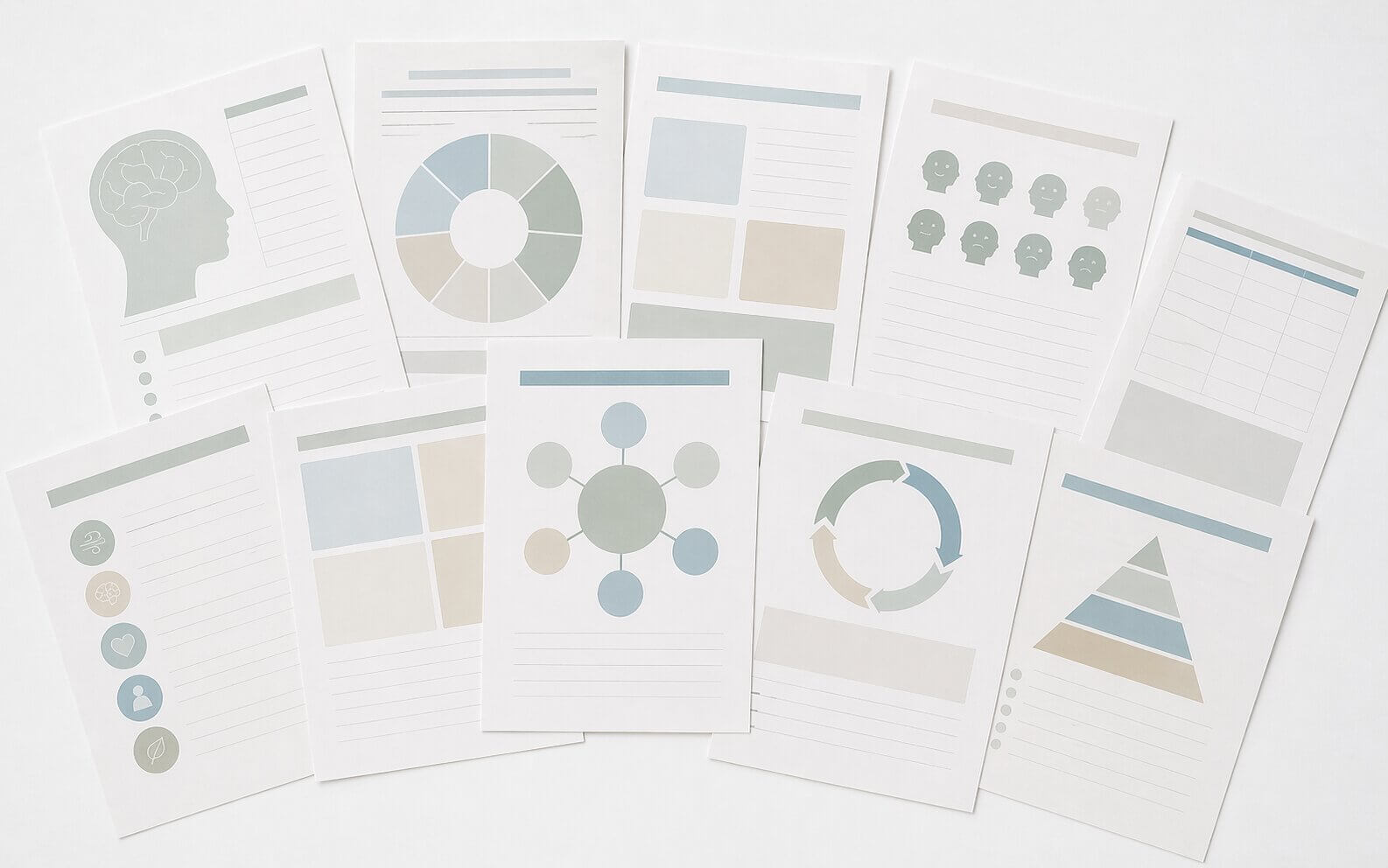
Therapy worksheets
Worksheets are one of the most consistently useful resource types across all practice settings. A well-designed worksheet gives clients something to work with between sessions, reinforces the framework you are using, and reduces the explaining work on your end.
The most in-demand therapy worksheets for Australian practice cover cognitive restructuring, behavioural activation, values clarification, emotion tracking, self-compassion, and regulation strategies. Evidence-based frameworks — CBT, ACT, DBT, schema therapy — drive the most usage, but strengths-based and trauma-informed tools have grown significantly as practice approaches have diversified.
Browse therapy worksheets for Australian clinicians on PsychVault.
NDIS report templates and documentation tools
NDIS documentation is one of the highest administrative burdens in Australian allied health. Writing reports that satisfy NDIA decision-makers requires clear functional impact language, explicit links to disability-related need, and well-structured recommendations — none of which come naturally from standard clinical training.
Strong NDIS resources help clinicians structure their reports so that the reasoning is clear, the wording is appropriate, and the recommendations are specific enough to be actioned. This includes both full report frameworks and targeted wording tools for specific sections.
Browse NDIS resources for psychologists on PsychVault.
Psychoeducation handouts
Psychoeducation is a core component of most evidence-based therapies. When clients understand what is happening for them — what anxiety actually is, how trauma affects the nervous system, why sleep and mood are connected — the therapeutic work moves faster.
Good psychoeducation handouts are plain-language, visually clear, and designed for use in session rather than as standalone education tools. They reduce explaining work, give clients language they can use at home, and reinforce the tone and approach of the therapy.
Browse psychoeducation handouts for Australian practice on PsychVault.
Report templates
Beyond NDIS, Australian clinicians write a wide range of structured reports: school psychology assessments, Medicare-linked psychological reports, medico-legal assessments, custody evaluations, and complex clinical case formulations.
Each of these has different documentation requirements. Templates help reduce the blank-page problem — they give clinicians a structure to work inside rather than starting from scratch every time.
Browse psychology report templates for Australian clinicians on PsychVault.
Assessment tools
Screening tools, structured checklists, and observational frameworks support the assessment phase of clinical work. While full standardised assessments require training and licensing, a range of structured screening and intake tools can be legitimately used by psychologists and allied health professionals across practice settings.
Browse assessment tools for Australian psychologists on PsychVault.
What makes a good clinical resource

Not all resources are created equal. When you are evaluating whether a psychology resource is worth using, a few questions cut through most of the noise.
Is the evidence base clear? A resource built on an established framework — CBT, ACT, DBT, motivational interviewing — is more likely to be clinically defensible than something built on vague wellness language. You do not need a citation on every handout, but the conceptual foundation should be identifiable.
Is it designed for the right reading level? Psychoeducation handouts and therapy worksheets intended for clients need to be accessible. That usually means written at a Year 8–10 reading level, avoiding jargon, and using short sentences. Resources designed for clinician training are often too dense for direct client use.
Is it printable and practical? A resource that looks elegant on screen but prints badly is not useful in a clinical setting. Good clinical resources are designed to work in A4, print in black and white if needed, and look credible on paper.
Is it adapted for Australian context? This matters most for NDIS tools, report templates, and anything referencing healthcare services. The resource should reflect Australian systems, not default to US or UK frameworks.
Has it been made by a practising clinician? Resources built by people with real clinical experience tend to include the details that matter — the wording that actually satisfies a planner, the exercise that fits naturally into a 50-minute session, the handout that a client will actually pick up off their coffee table and read.
Where to find psychology resources in Australia

PsychVault
PsychVault is a marketplace specifically built for Australian psychologists and allied health professionals. Resources are uploaded by practising clinicians and cover the full range of clinical documentation, therapy tools, and psychoeducation needs. The platform includes both free and paid resources, with previews so you can evaluate before purchasing.
Browse psychology resources for Australian clinicians, or start with free resources if you want to explore without a financial commitment.
Centre for Clinical Interventions (CCI)
The Centre for Clinical Interventions, based in Perth, produces free evidence-based modules and worksheets primarily for anxiety, depression, eating disorders, and perfectionism. Their resources are freely available and widely used in Australian clinical practice. They are clinician-authored and aligned with CBT and third-wave frameworks.
Australian Psychological Society (APS)
The APS publishes practice-related resources, guidelines, and position papers that are directly relevant to Australian clinical standards. While not a resource marketplace, the APS is an important source of position statements, ethical guidelines, and practice recommendations that inform how clinical resources should be designed and used.
Building a resource library that works

The most effective approach to clinical resources is to build a curated library over time — not to collect everything, but to identify the tools you reach for repeatedly and make sure they are the best available version.
Start with the areas of highest clinical need in your practice. If you work with NDIS participants, invest time in finding strong report templates and functional impact wording tools. If you run CBT-based therapy, build a bank of worksheets that match the framework well. If you have a significant paediatric or family caseload, prioritise parent handouts and school-focused materials.
Quality over quantity matters. Twenty excellent resources you use consistently will serve your practice better than a hundred that sit unused.
PsychVault is designed to make this process easier — a central place to find psychology resources for Australian clinicians, preview before you download, and build a library that reflects how you actually work.
If you are looking for a starting point, free resources are available without any commitment. For the tools you come back to regularly, the paid options are typically more comprehensive and more polished.
PsychVault is a marketplace for psychology and allied health resources built for Australian practice. Resources are uploaded by practising clinicians and cover therapy, assessment, NDIS documentation, psychoeducation, and more.
Discussion
Share your thoughts and experiences with this resource.
Sign in to leave a comment
Comments
Browse real clinician-designed resources
Move from strategy into implementation with templates, handouts, and psychoeducation tools already live on the marketplace.
Turn your own resources into a polished store
Publish clinician-grade templates, build trust signals, and start growing an evergreen library under your own brand.
Keep the topic cluster growing

A practical guide to the psychology templates clinicians use most — CBT worksheets, intake forms, case formulation, behaviour support, and NDIS documentation.

A practical guide for psychologists and clinicians on writing progress notes that satisfy clinical, legal, and funding requirements without turning documentation into a second full-time job.

Understand the NDIS reasonable and necessary criteria and learn how to write psychology reports that justify supports clearly for Australian clinicians.