
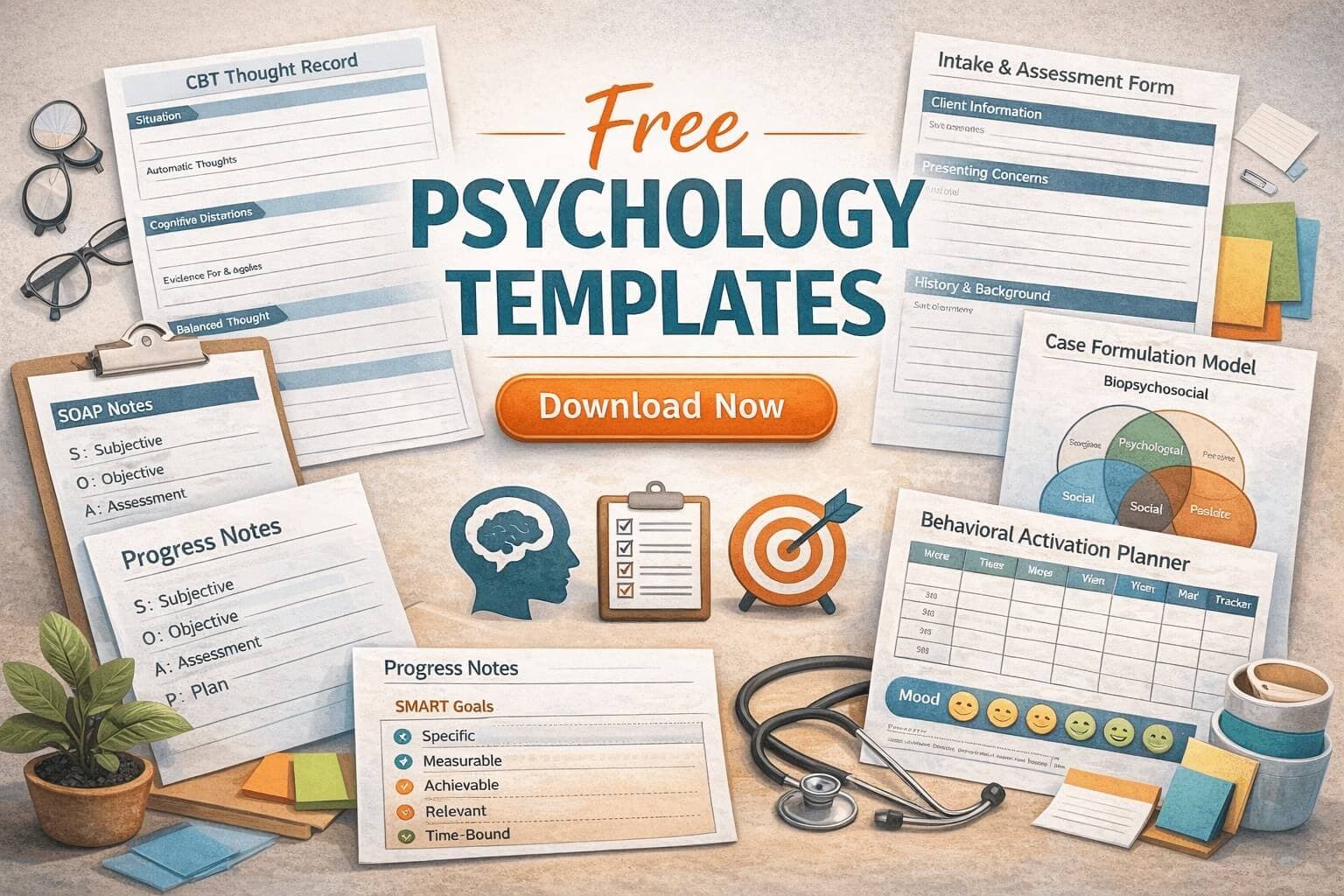
Psychology Templates Free Download
Access free psychology templates including CBT worksheets, assessment tools, and clinical resources designed for clinicians, students, and mental health creators.
Why psychology templates matter more than you think
Most clinicians, students, and creators spend far too much time rebuilding the same documents.
Progress notes. Intake forms. Worksheets. Reports.
Good templates remove that friction.
They allow you to focus on clinical thinking, client engagement, and decision-making, instead of formatting documents from scratch every time.
The right template doesn't just save time. It improves the quality and consistency of your work.
What are psychology templates?
Psychology templates are structured tools used to support common mental health workflows, including:
- client intake and assessment
- case formulation
- therapy worksheets
- progress notes and reports
- behaviour support planning
They act as a framework for thinking, not just documentation.
Free psychology templates you can use right now
If you want ready-to-browse options first, start with all free resources, free psychoeducation resources, or free therapy worksheets.
One useful example already live on the site is the Autism-Friendly Psychoeducation Handout, which gives you a free, neurodiversity-affirming handout you can review straight away.
Below are high-value templates that are widely used across clinical, educational, and NDIS contexts.
CBT Thought Record Worksheet
Best for: Anxiety, depression, cognitive restructuring
Includes:
- Situation breakdown
- Automatic thoughts
- Cognitive distortions
- Evidence for and against
- Balanced thought
Use case: Ideal for between-session work or collaborative in-session cognitive restructuring.
Intake and Initial Assessment Template
Best for: First sessions and comprehensive intake
Includes:
- Presenting concerns
- Background history
- Risk screening
- Goals and expectations
Use case: Provides structure while still allowing flexibility in clinical interviewing.
Case Formulation Template (Biopsychosocial)
Best for: Integrating assessment data into a clear model
Includes:
- Predisposing factors
- Precipitating factors
- Perpetuating factors
- Protective factors
Use case: Supports treatment planning and shared understanding with clients.
Behavioural Activation Planner
Best for: Depression and low motivation
Includes:
- Weekly activity scheduling
- Mood tracking
- Values-based planning
Use case: Helps translate insight into action through small, achievable steps.
If that kind of resource is what you're after, it's also worth checking free resources and the broader therapy worksheets category.
Behavioural Escalation Profile
Best for: Behaviour support and NDIS contexts
Includes:
- Escalation stages from calm through to recovery
- Triggers and early warning signs
- De-escalation strategies
Use case: Supports consistent responses across caregivers, teachers, and support staff.
For related material, browse NDIS resources and positive behaviour support resources.
Goal Setting Worksheet (SMART Goals)
Best for: Therapy planning and reporting
Includes:
- Specific, measurable goal structure
- Short and long-term targets
- Progress tracking
Use case: Helps clients move from vague intentions to clear outcomes.
You might also want goal setting and intervention plans and feedback and formulation resources.
How to use templates effectively
Templates are most powerful when used flexibly.
Adapt, don't rigidly follow
They should guide your thinking, not replace it.
Keep them simple
Overly complex templates often go unused.
Match the client
Adjust language and structure depending on age, neurotype, and context.
Use them collaboratively
Templates work best when completed with the client, not just for them.
What makes a good psychology template?
A high-quality template usually:
- is clear within seconds
- uses simple but clinically accurate language
- has strong visual structure and spacing
- avoids unnecessary clutter
- feels like something you would actually use in session
If a template feels confusing or heavy, it likely won't be used consistently.
Why template content performs so well
Psychology templates sit at the intersection of clinician and client search intent.
People regularly search for:
- CBT worksheet free
- therapy templates PDF
- psychology intake form
- NDIS report template
- behavioural activation worksheet
This makes them one of the strongest categories for:
- organic traffic
- content discovery
- resource marketplaces
When paired with useful blog content, templates naturally drive discovery and engagement.
Final takeaway
Psychology templates are not just downloadable documents.
They are clinical tools that:
- reduce cognitive load
- improve consistency
- support better client outcomes
The best templates feel like an extension of your clinical work, not an add-on.
Want more templates?
If you want to keep browsing, start with:
- All free resources
- Free psychoeducation handouts
- Free therapy worksheets
- Autism-Friendly Psychoeducation Handout
- Browse all resources
If you want more structured documentation tools, also take a look at report templates, NDIS resources, and parent handouts.
Browse real clinician-made resources
Move from strategy into implementation with templates, handouts, and psychoeducation tools already live on the marketplace.
Turn your own resources into a polished store
Publish clinician-grade templates, build trust signals, and start growing an evergreen library under your own brand.
Keep the topic cluster growing

NDIS report template checklist for psychologists who want faster approvals
A practical checklist for writing clearer NDIS psychology reports with stronger functional wording, cleaner recommendations, and less admin drag.

How to make psychoeducation handouts clinicians actually want to use
A practical guide to creating psychoeducation handouts that feel credible in session, read clearly for clients, and perform better as digital products.

How to sell psychology resources online without looking spammy
A grounded guide for clinicians who want to sell psychology resources online while still sounding credible, helpful, and professionally aligned.