
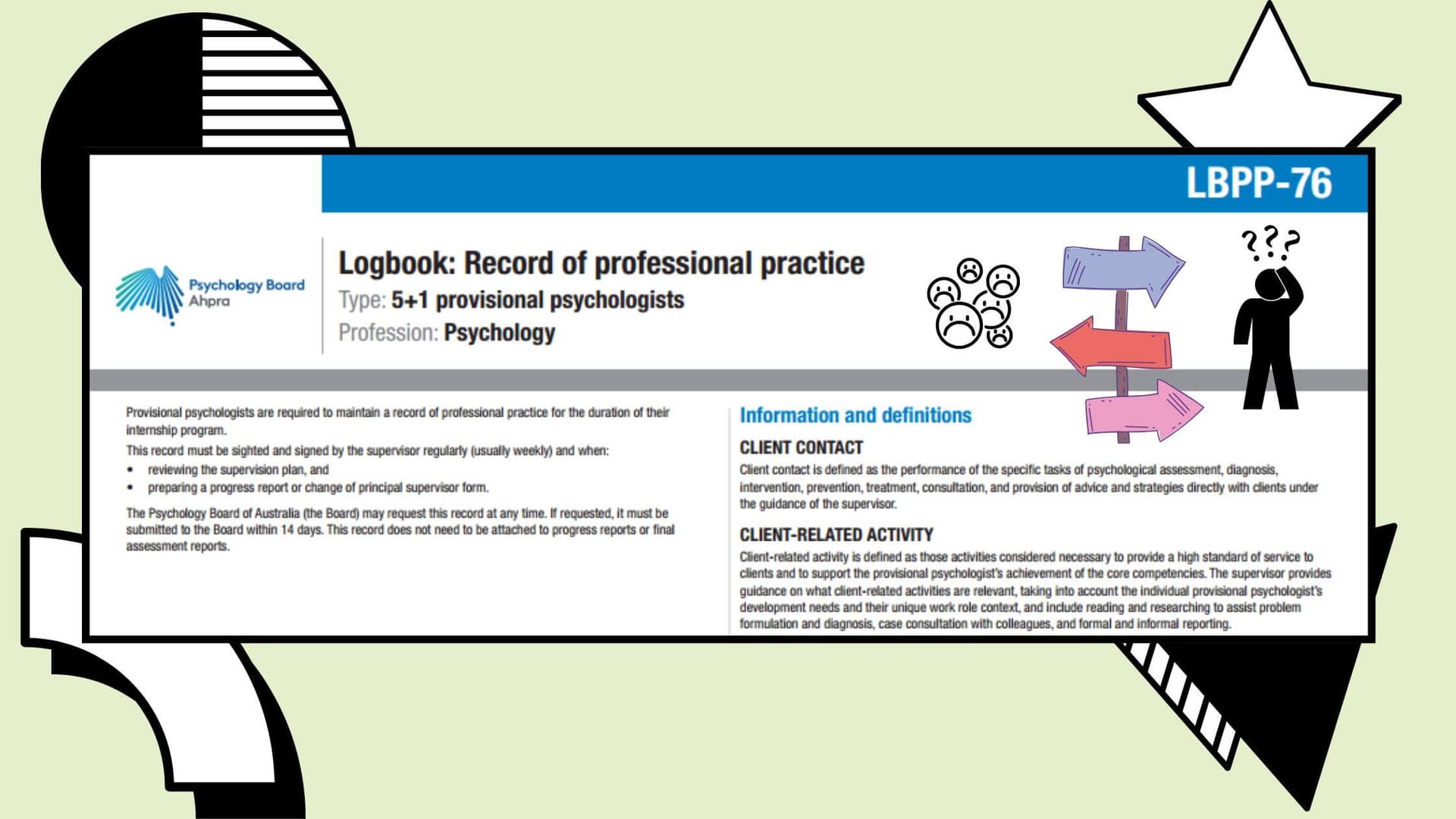
How to Keep Your LBPP-76 Logbook Up to Date Without Falling Behind
A practical weekly system for provisional psychologists doing the 5+1 internship — built from real logbook experience, not the AHPRA website.
Nobody warns you how much time the LBPP-76 logbook actually takes.
You finish your fifth year, you start your internship, you see clients, you write notes — and somewhere in the background the logbook is quietly accumulating entries that need to be written, hours that need to be categorised, reflections that need to say something more than "the session went well."
Most provisional psychologists spend two to three hours a week on their logbook. The ones who have a proper system spend one hour — and they go into supervision prepared, not scrambling.
This post is about building that system. Not the AHPRA-compliant minimum. The actual working version, built from real internship experience.
Jump to a section:
- What the 5+1 internship actually requires
- Why most provisional psychologists fall behind
- The core insight most people miss
- The master spreadsheet: what it is and why it matters
- Client anonymisation: a practical approach
- The weekly system: how it actually runs
- What to write in your reflections
- The arrangement with your supervisor
- What the Board actually needs to see
- If you have fallen behind
- The logbook guide that makes this easier
- The honest summary
What the 5+1 internship actually requires
Before the system, you need to understand what you are building toward. The 5+1 internship has three components and the hours can feel abstract until you map them out.
| Requirement | Minimum |
|---|---|
| Total internship hours | 1,500 hours |
| Supervised psychological practice | 1,360 hours |
| Direct client contact | 500 hours (up to 60 can be simulated) |
| Total supervision hours | 80 hours |
| Individual supervision with principal supervisor | 50 hours |
| Professional development / education & training | 60 hours |
| Supervisor direct observations | 8 sessions total (minimum 2 assessment + 2 intervention per 6 months) |
The supervision ratio changed under the December 2025 guidelines. Previously the requirement was 1 hour of supervision for every 17 hours of practice. Under the updated guidelines, the mandatory ratio has been removed — the Board now suggests approximately 1 hour of supervision per 18 hours of practice as a guide, with the expectation that supervision occurs weekly while you are practising. The ultimate frequency is agreed between you and your principal supervisor.
One other significant change from December 2025: case studies and progress reports no longer need to be submitted to AHPRA. Your supervisor still completes a final assessment of competence at the end of the internship, and the logbook still needs to be maintained and reviewed regularly — but the administrative burden has been reduced considerably.
Why most provisional psychologists fall behind

The logbook feels manageable at the start of your internship because you do not have many clients yet. You have two or three on your caseload, the entries take minutes, and you wonder what all the fuss is about.
Then your client load builds. New referrals come in. Some weeks you have eight or ten client contacts to document. You have a sick day. You have a week where supervision prep consumes every spare moment. You tell yourself you will catch up on the weekend — and then you do not.
By week six or eight, you are two weeks behind. The logbook is starting to feel like a debt rather than a record.
The problem is not discipline. The problem is that building a caseload and building a logbook system are happening at exactly the same time, and the system never quite catches up to the caseload.
The fix is to build the system before the caseload gets heavy — even if it feels like overkill in the first few weeks.
The core insight most people miss
Here is the thing about the weekly logbook hour that almost nobody talks about: that hour counts as client-related activity (CRA).
Under the AHPRA guidelines, client-related activity is any activity directly related to your supervised psychological practice that is not direct client contact. Reviewing your clinical notes, reflecting on sessions, preparing documentation — all of it sits under CRA.
When you sit down to do your logbook, you are reflecting on clinical work. You are reviewing what happened across the week, what you observed, how you responded, what you would do differently. That is unambiguously CRA.
So the logbook hour is not admin time stolen from your internship. It is part of your internship. Log it that way, with a description like "weekly clinical reflection and logbook documentation" — and confirm this approach with your supervisor so you are both aligned from the start.
The supervision session itself is logged separately as supervision. The logbook hour is CRA. They are two different things.
The master spreadsheet: what it is and why it matters

The foundation of an efficient weekly system is a master spreadsheet — a separate document that lives alongside your official LBPP-76.
The master spreadsheet holds your client reference list. For each client, you record:
- Their anonymisation code (more on this below)
- Their presenting issue or diagnosis
- Their treatment framework (CBT, ACT, behaviour support, etc.)
- Session number tracker
- Any fixed details you will repeat in logbook entries — presenting problem summary, relevant history, modality
Each week, when you sit down to do your logbook, you are not starting from scratch for established clients. You open the master spreadsheet, copy the relevant client string, paste it into the logbook entry, and update the session-specific details: what occurred in session, what the session number was, any changes to presentation.
For a client you have seen twelve times, this takes about ninety seconds per entry.
The catch is that new clients break the system. When a new referral arrives, you cannot paste — you have to formulate. You need to write their presenting problem clearly enough that it becomes a usable string for every future entry. This is where the system demands real time, usually fifteen to twenty minutes for a new client's first entry.
This is why the hardest period of the internship for logbook management is not the busy middle — it is the early weeks when you are building your caseload and setting up every client from scratch simultaneously.
Do not underestimate this. Block extra time in weeks two through six. Once your client list is established and the master spreadsheet is populated, the system becomes genuinely fast.
Client anonymisation: a practical approach
AHPRA requires that clients are not identifiable in the logbook. You need a consistent reference code for each client that you can look up quickly without thinking.
One approach that works well: use the client's file number or user ID from your practice management software — Zanda, PowerDiary, Halaxy, or whatever system your practice uses. If a client's file number in Zanda is 76544, that is their logbook code: 76544.
The reason this works is that it creates a direct bridge between your clinical notes and your logbook. When you are writing a logbook entry, you open the client's note in your practice software, note the file number, and your master spreadsheet entry for that code tells you everything else you need. The client is identifiable to you in context, completely anonymous in the logbook.
Discuss this approach with your supervisor before you start and make sure they are comfortable with it.
The weekly system: how it actually runs

Pick one day and block one hour. Put it in your calendar as a fixed appointment — not a vague intention. Friday afternoon works well because the week is fresh, you are about to go into the weekend, and it sets you up for supervision the following week. Some people prefer Sunday evening. The day matters less than the consistency.
Open your master spreadsheet and your LBPP-76 side by side. Work through each client contact from the week in order. For established clients: copy the client string, paste, update session number, write two to three sentences on what occurred in session, update the activity type and hours.
Log the logbook hour itself as CRA before you close the document. Date it, describe it as clinical reflection and documentation, log the hour.
Prepare for supervision at the same time. As you work through entries, note anything that feels unresolved — a session that did not go as planned, a client you are uncertain about, a clinical question you want to bring. Your logbook review and your supervision prep become the same activity.
Send to your supervisor on schedule. Agree with your supervisor upfront on the review arrangement — weekly or fortnightly depending on whether you are full-time or part-time, as the December 2025 AHPRA guidelines recommend. Some supervisors prefer to clear entries via email once they are satisfied with the format, rather than reviewing every entry in the supervision session itself. Get this arrangement in writing — an email chain confirming the process is sufficient — so the review record is clear if the logbook is ever requested by the Board.
What to write in your reflections

This is where most provisional psychologists get pushed back — and it is usually because their reflections read like session summaries rather than actual reflections.
A session summary says: "Client presented with low mood. We worked on behavioural activation. Client was receptive."
A reflection says something more like: "I noticed I moved into problem-solving mode quite quickly when the client became tearful, which I think was my own discomfort with sitting in the distress. I want to work on tolerating that pause better. I will bring this to supervision and try to stay with the silence longer next session."
The difference is that a reflection includes:
- Your emotional or clinical response — what you noticed in yourself, not just in the client
- What you are uncertain about or would do differently — genuine clinical thinking, not a verdict
- An action — what you will actually do as a result, even if it is just "raise in supervision"
Reflections do not need to be long. Three to five sentences that genuinely engage with those three elements is more useful than a paragraph of clinical description. Your supervisor is looking for evidence that you are developing as a clinician, not a verbatim account of the session.
If your reflections are being pushed back on, the most common reason is that they are missing the emotional and action components — they read as competent observations rather than genuine professional development.
The arrangement with your supervisor

The logbook review process does not have to happen in real time during every supervision session. A practical arrangement that works well:
- You complete and send your logbook entries weekly (or fortnightly if part-time)
- Your supervisor reviews and confirms receipt via email — a brief "reviewed and happy with format" is sufficient
- You batch sign or initial the entries together, perhaps monthly, during a supervision session
This keeps the supervision session focused on clinical work rather than administrative review, while maintaining a clear record of supervisor oversight. The email trail serves as the confirmation that review has occurred.
Get the arrangement agreed and documented before your internship starts. If you change supervisors mid-internship, the CHPS-76 form documents what has been agreed and completed to date — so clarity in the arrangement protects you if anything is disputed later.
What the Board actually needs to see

The LBPP-76 can be requested by AHPRA at any time during your internship — and you have 14 days to submit it if it is. This is not a theoretical risk. It happens.
What the Board is looking for is evidence that you are engaged in genuine supervised psychological practice, that your supervision is occurring regularly and being documented, and that you are developing competency across the required domains.
A logbook that is up to date, clearly structured, with genuine reflections and a documented supervisor review process will satisfy that test. A logbook that is three weeks behind, with thin reflections and no clear supervisor sign-off trail, will not — even if all your hours are technically correct.
One detail worth noting: the December 2025 AHPRA guidelines updated the supervision frequency guidance. The previous rule was 1 hour of supervision for every 17 hours of internship practice. Under the updated guidelines, the mandatory ratio has been removed — the Board now suggests approximately 1 hour of supervision per 18 hours of practice as a recommendation, not a hard requirement. Supervision is expected to occur weekly while you are practising, with the exact frequency agreed between you and your principal supervisor.
The weekly system is not about perfectionism. It is about maintaining a record that accurately reflects real clinical work, in a format that is defensible if it is ever scrutinised.
If you have fallen behind

If you are already behind — weeks or months of entries still to write — do not try to write everything from memory at the maximum level of detail. Write what you genuinely remember. Keep it accurate. Note in entries where your recall is limited. Do not backfill reflections with invented content.
Then build the weekly system from this week forward, regardless of what is behind you. A clean, consistent record from now is more valuable than a reconstructed one that looks perfect but may not hold up.
Bring the situation to your supervisor. Most supervisors have seen this before and would rather help you establish a sustainable system than discover at the end of the internship that the logbook is not audit-ready.
The honest summary
The LBPP-76 is not complicated once you understand it. The weekly system that works is:
- A master spreadsheet that holds your client strings so you are not writing from scratch each week
- A fixed one-hour block, same day every week, logged as CRA
- A supervisor review arrangement confirmed in writing from the start
- Reflections that include your emotional response, your uncertainty, and an action — not just a session summary
- New clients treated as a real investment: take the time to set them up properly in week one
The hardest part is the beginning, when you are building the caseload and the system at the same time. Push through that period with extra time blocked, and the rest of the internship becomes genuinely manageable.
The logbook guide that makes this easier
If you want a complete breakdown of every section of the LBPP-76 — including worked examples for Section A entries, how to write reflections that satisfy your supervisor, how to document supervision in Section C, and a PD tracking system for Section B — the PsychVault LBPP-76 Logbook Guide covers all of it.
It is the resource we wish had existed at the start of the internship. Written by a provisional psychologist who has completed the logbook, for provisional psychologists who are about to. Download the LBPP-76 Logbook Guide →
PsychVault's LBPP-76 Logbook Guide covers the full logbook in detail — sections A through D, hour categorisation, supervision documentation, PD tracking, and a weekly system you can implement immediately. Available for instant download.
Discussion
Share your thoughts and experiences with this resource.
Sign in to leave a comment
Comments
Browse real clinician-designed resources
Move from strategy into implementation with templates, handouts, and psychoeducation tools already live on the marketplace.
Turn your own resources into a polished store
Publish clinician-grade templates, build trust signals, and start growing an evergreen library under your own brand.
Keep the topic cluster growing

A practical guide to finding psychology resources that actually work in Australian practice — covering templates, handouts, NDIS tools, and what makes a clinical resource worth using.
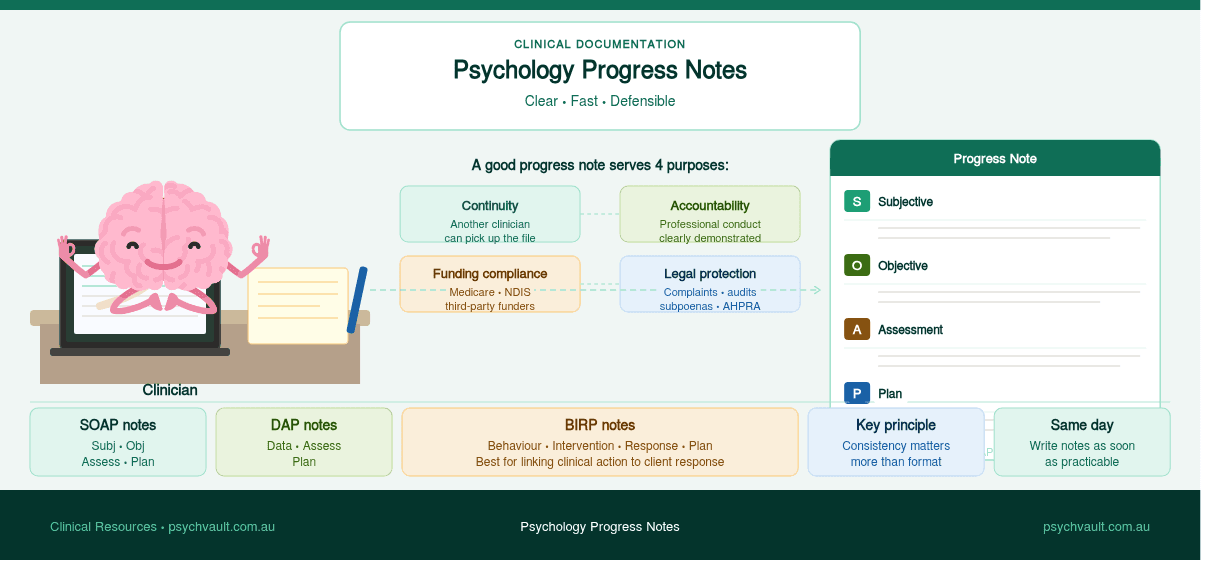
A practical guide for psychologists and clinicians on writing progress notes that satisfy clinical, legal, and funding requirements without turning documentation into a second full-time job.

Understand the NDIS reasonable and necessary criteria and learn how to write psychology reports that justify supports clearly for Australian clinicians.