

The Clinical Hours Trap Nobody Warns You About Before You Start a Clinical Masters
What happens to your progress if admin issues push you out of a clinical masters in semester one, and why the answer might surprise you.
Nobody tells you this part before you start.
You get into a clinical masters program. You are excited. You fought hard for the spot, often against applicants who already hold a masters degree. You begin placement. Coursework starts. You are finally doing the work you trained for.
Then something goes wrong. Not clinically. Not academically. Administratively.
An enrolment issue. A fee misunderstanding. A communication breakdown that nobody catches in time. One mistake leads to another until a student who was doing everything right suddenly has to withdraw or has their enrolment cancelled before the semester ends.
Only then do you discover what that actually means for everything you gave up to get there.
We have seen this happen up close. Not as a hypothetical. The downstream consequences can be devastating emotionally, professionally and financially, and they can follow a provisional psychologist for years.
This article is for anyone considering a clinical masters after beginning the 5+1 internship, or anyone currently in a program who wants to understand what is at stake if things go wrong early. It is not meant to scare you away. It is meant to give you information many students only learn the hard way.
Jump to a section:
- The two pathways are separate streams
- What you give up when you accept a clinical masters offer
- What happens to semester one coursework if you exit
- What happens to your 5+1 hours
- The three-year clock
- The limbo scenario nobody talks about
- The semester one window is the most vulnerable
- Why admin issues are more common than many students expect
- The one thing that saved a significant portion of our hours
- What to do before something goes wrong
- If you are already in this situation
The two pathways are separate streams
Before anything else, this needs to be clear. The 5+1 internship pathway and the higher degree pathway, including Master of Clinical Psychology and Doctor of Psychology programs, are generally treated as separate registration streams.
This is not a technical detail buried in policy documents. It has real consequences for anyone who moves between them, and it shapes everything else in this article.

What you give up when you accept a clinical masters offer
If you are progressing through the 5+1 internship and accept a clinical masters offer, you are typically leaving the 5+1 stream. The hours already accumulated during the internship usually do not transfer into the higher degree program. You are entering a different pathway and the clinical requirements restart within that structure.
Most students understand this trade-off. The clinical masters is a more specialised pathway and the expectation is that you complete its requirements in full.
What fewer students understand is what can happen if the clinical masters does not work out.
What happens to semester one coursework if you exit
If a student leaves a clinical masters program before the end of the first semester, coursework completed during that period may not be formally recognised. This can occur even when units are accredited. The work often does not count toward re-entry into the same program and may not transfer to other pathways.
In practical terms, this can mean losing an entire semester of academic work alongside everything else.
For students who were attending placement, submitting assignments and engaging fully, this can be one of the most painful parts of an early exit.
What happens to your 5+1 hours
Because the 5+1 pathway was paused or exited when the clinical masters began, those hours do not automatically return if you leave the program.
Recovering them usually requires a formal assessment through the Psychology Board of Australia via AHPRA. This process takes time and relies heavily on documentation. Outcomes vary because each case is assessed individually.
The key point is documentation.
Hours that were not formally signed off at the time they were completed may be difficult or impossible to recover later. If supervision sessions were never documented, they generally cannot be counted after the fact. If a sign-off cycle was interrupted, the unsigned portion may not be recoverable.
The Board can only assess what is recorded.
Another area that is often unclear is the National Psychology Exam. Whether NPE results carry over when returning to the 5+1 pathway depends on individual circumstances and timing. This is something that needs to be confirmed directly with AHPRA.

The three-year clock
The 5+1 internship operates within a registration timeframe. Provisional psychologists typically have a limited window, often around three years from initial provisional registration, to complete the internship before renewal or re-application requirements apply.
Time spent in a clinical masters program may count toward this window depending on registration status. If a significant portion of that timeframe has passed, returning to the 5+1 pathway can become much more complicated.
If the window has closed, re-application to AHPRA may be required. This can involve re-establishing provisional registration and resubmitting documentation even after years of training and supervised experience.
The limbo scenario nobody talks about
This is where the risks intersect.
A student exits the clinical masters due to administrative issues. Their first-semester coursework is not recognised. Their 5+1 hours require formal assessment. They decide to reapply to the clinical masters.
This time, their grades are no longer competitive.
Clinical masters programs in Australia are highly competitive. Previous enrolment does not guarantee priority for re-entry. If academic results were affected by stress, disability, personal crisis or the circumstances surrounding the exit, the application may not reach interview stage.
The result can feel like limbo. Re-entry to the clinical masters is uncertain, while returning to the 5+1 pathway may require restarting the registration process.
Neither door is clearly open, and the event that closed them was not clinical or academic failure. It was administrative breakdown.
The semester one window is the most vulnerable
The first semester of a clinical masters is often when students are most exposed.
Everything is new. Enrolment systems, fees, placements, supervision and academic expectations all begin at once. Administrative processes are at their busiest at the start of the year.
If something goes wrong, it often happens here. If a student exits before the semester closes, documentation and sign-off processes may not yet be complete.
No sign-off means no record. No record means little evidence to take forward.
Why admin issues are more common than many students expect
Students entering clinical masters programs are motivated and capable. They are also navigating large university systems that were not designed specifically for provisional psychologists.
Fees, Tax File Numbers, enrolment status and portal access are generic processes. Communication gaps between departments can lead to conflicting advice. Students may follow guidance in good faith and still face penalties when systems fail.
Students with disabilities can face additional barriers. Accessing disability services requires early planning and self-advocacy at a time when many students are already under pressure.
Add a personal crisis, a health issue or a family emergency and administrative complexity can quickly become overwhelming.
These are not rare circumstances. They are real-life events happening during the same years students are completing clinical training.

The one thing that saved a significant portion of our hours
There is one practical lesson worth highlighting.
When a supervisor changes during placement, a form is usually completed to document hours accumulated up to that point. This form creates a standalone record of supervised practice.
In our experience, this documentation made a significant difference during the AHPRA assessment process. Without it, far fewer hours would likely have been recoverable.
If you change supervisors, ensure this form is completed at the time of the change. Do not assume it will happen automatically. Follow up until it is done.
It may become one of the most important documents connected to your training.
What to do before something goes wrong
Protecting yourself early can make a significant difference.
- Understand how your program documents hours and coursework.
- Keep your own records of supervised sessions and assignments.
- Learn enrolment and fee processes before deadlines approach.
- Register with disability services early if you need support.
- Have explicit conversations with supervisors about documentation.
- If you face a personal crisis, escalate formally and early.
These steps are far easier to take before problems arise.
If you are already in this situation
If you have exited a clinical masters and feel unsure about your next steps, the process may still have options.
- Contact AHPRA for advice specific to your registration status.
- Gather all documentation related to placement, supervision and coursework.
- Consider formal complaint pathways if administrative failures played a role.
- Seek advice from experienced psychologists familiar with the registration system.
You do not have to navigate the situation alone.
The clinical masters pathway is one of the most demanding routes into the profession. Students who pursue it invest years of study, financial sacrifice and personal commitment. They deserve to understand that the risks are not only clinical or academic. Administrative processes can shape outcomes in ways many students never anticipate.
Many of the lessons in this article shaped the resources we have created to help provisional psychologists document their work properly and protect themselves early. If you are navigating the 5+1 pathway and want tools designed to prevent the risks described here, you can explore our logbooks, supervision templates and documentation resources at PsychVault.
Note: Registration requirements, pathway rules and timeframes are set by the Psychology Board of Australia and administered by AHPRA. This article reflects general experience and is not legal or registration advice. Always confirm your specific situation directly with AHPRA.
Discussion
Share your thoughts and experiences with this resource.
Sign in to leave a comment
Comments
Browse real clinician-designed resources
Move from strategy into implementation with templates, handouts, and psychoeducation tools already live on the marketplace.
Turn your own resources into a polished store
Publish clinician-grade templates, build trust signals, and start growing an evergreen library under your own brand.
Keep the topic cluster growing
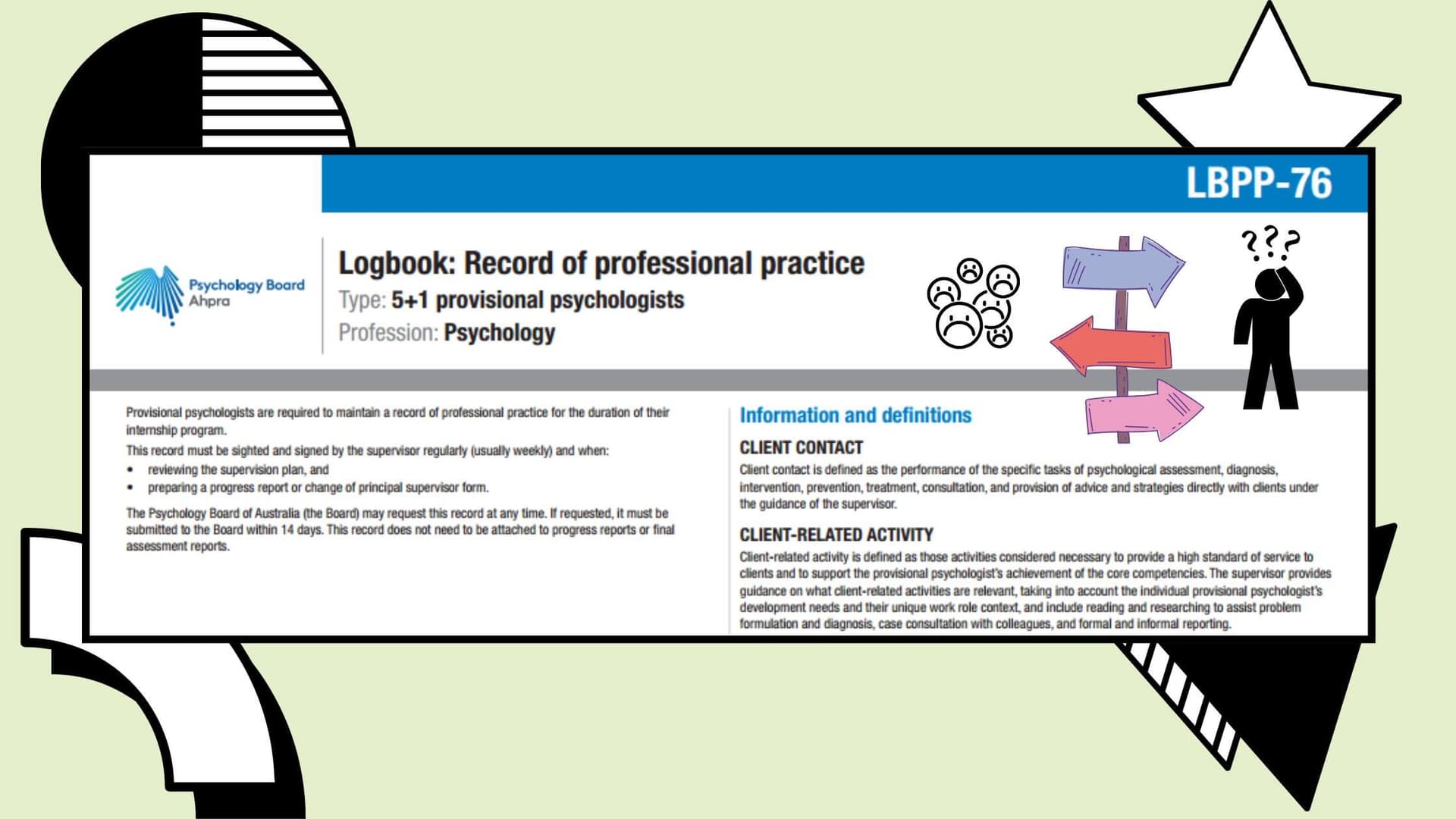
A practical weekly system for provisional psychologists doing the 5+1 internship — built from real logbook experience, not the AHPRA website.

A practical guide for Australian psychologists and allied health clinicians on what neuroaffirming documentation actually means, and how to spot it in the resources you use.

A practical guide to finding psychology resources that actually work in Australian practice — covering templates, handouts, NDIS tools, and what makes a clinical resource worth using.